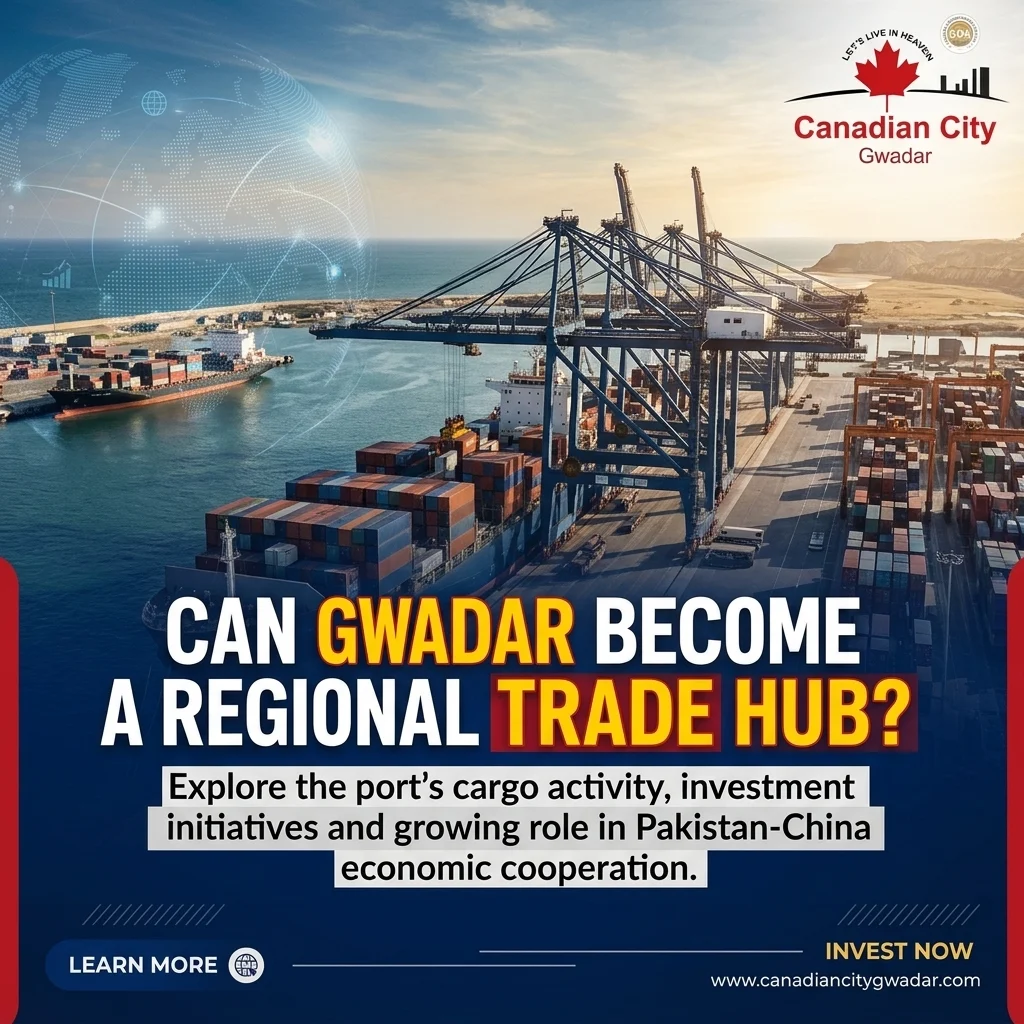
Can Gwadar Become a Regional Trade Hub? Understanding Its Economic Potential and Future Opportunities
Introduction to Gwadar’s Growing Economic Importance
Can Gwadar become a regional trade hub? This is one of the most important questions surrounding Pakistan’s economic future. Located along the Arabian Sea in Balochistan, Gwadar has attracted international attention because of its strategic location, deep-sea port, infrastructure development, and growing connection with the China-Pakistan Economic Corridor (CPEC). The city is no longer discussed only as a coastal destination or fishing town. It is increasingly part of conversations about international shipping, regional connectivity, logistics, industrial development, and foreign investment. With countries looking for efficient trade routes and alternative transportation networks, Gwadar has an opportunity to establish itself as an important economic gateway.
The real potential of Gwadar comes from its ability to connect different regions through maritime and land transportation. China, Pakistan, Afghanistan, Iran, and Central Asian countries could benefit from improved trade connections through this coastal city. However, becoming a regional trade hub requires much more than geographical advantages. It needs reliable infrastructure, competitive port charges, international shipping services, modern logistics facilities, stable policies, and strong commercial relationships. Pakistan has already invested considerable resources in developing Gwadar, but the next stage must focus on converting infrastructure into sustainable economic activity. If these priorities receive consistent attention, Gwadar could become an important contributor to Pakistan’s economy and regional commerce.
Why Is Gwadar Geographically Important?
Geography is one of Gwadar’s strongest advantages. The city is situated on Pakistan’s southwestern coastline, close to the Gulf of Oman and the Strait of Hormuz. This location places Gwadar near important international maritime routes connecting the Middle East, South Asia, Africa, and other global markets. Ships travelling through these waters carry energy resources, industrial products, agricultural commodities, machinery, and consumer goods. A port positioned close to major shipping routes can potentially attract international shipping companies and businesses seeking efficient cargo transportation.
Gwadar also offers Pakistan an opportunity to expand its economic connections beyond traditional commercial centres. Karachi and Port Qasim currently handle the majority of the country’s maritime trade, but Gwadar can complement these ports by developing specialized commercial activities. Its location could make it particularly useful for transshipment, regional cargo distribution, industrial imports, and exports. The city could also support trade with landlocked countries if transportation corridors become efficient and commercially attractive. This geographical advantage creates a strong foundation, but it is important to understand that location alone does not guarantee success. Businesses select ports according to transportation costs, service quality, reliability, and access to markets. Gwadar must perform well in all these areas to establish a lasting position in international commerce.

Gwadar’s Strategic Location on the Arabian Sea
The Arabian Sea is an important part of international maritime transportation. It connects shipping routes between the Indian Ocean, the Middle East, and major Asian economies. Gwadar’s location near these routes creates opportunities for shipping, cargo handling, warehousing, and logistics services. Its proximity to the Strait of Hormuz also gives it strategic significance in discussions about regional energy transportation and maritime security.
Another important advantage is Gwadar’s potential connection with the western regions of China and Central Asia. These areas need dependable transportation networks to access international markets. A combination of sea transportation, highways, border crossings, and logistics centres could create new trade possibilities. Gwadar may therefore become more than a port serving Pakistan’s domestic market. It could gradually develop into a regional commercial gateway serving multiple economies.
Gwadar Port – The Gateway to International Trade
Gwadar Port is the central element of the city’s economic vision. Developed as a deep-sea port, it has the potential to handle different categories of commercial cargo and support international shipping operations. The port is expected to complement Pakistan’s existing maritime infrastructure while creating additional opportunities for imports, exports, and transit trade. Its development under CPEC has increased international interest in Gwadar and strengthened its position in Pakistan’s long-term economic planning.
According to the official Gwadar Port Authority website, the port is intended to serve as a gateway for Pakistan and the wider region, including Afghanistan and Central Asian states. The authority identifies transshipment facilities and regional transit trade as important parts of its long-term vision. This demonstrates that Gwadar’s purpose extends beyond handling cargo for local markets. Its broader objective is to connect regional economies with international maritime transportation. However, achieving this objective will require consistent commercial activity, investment in supporting services, and stronger participation from international shipping operators.
Recent developments indicate that commercial operations are receiving renewed attention. The Gwadar Port Authority reported that the vessel MV Riva Glory arrived in April 2026 carrying 14,629 metric tons of cargo. The authority also reported the arrival of transshipment vessels during March, April, and May 2026. These developments are encouraging because regular vessel calls and cargo handling are essential for building confidence among shipping companies and traders. Nevertheless, long-term progress must be measured through sustained cargo volumes and regular international services rather than individual vessel arrivals.
Deep-Sea Port and Transshipment Opportunities
Transshipment is one of the most promising opportunities for Gwadar. It involves transferring cargo from one vessel to another so that goods can continue their journey to different international destinations. Large shipping companies often use major ports as distribution centres because they can combine cargo from multiple destinations and transport it through efficient maritime networks.
Gwadar could develop this business by attracting shipping companies that want to serve destinations across the Arabian Sea, the Middle East, Africa, and South Asia. A successful transshipment operation requires competitive port charges, efficient customs procedures, modern cargo equipment, dependable shipping schedules, and sufficient storage facilities. Businesses also need confidence that their shipments will arrive on time and that port operations will remain uninterrupted.
In its 2026 policy research, the Pakistan Institute of Development Economics (PIDE) highlighted that temporary disruptions in regional shipping created an opportunity for Pakistan’s ports, including Gwadar. However, the research also emphasized that temporary geopolitical developments cannot independently establish a successful transshipment business. Ports must remain commercially competitive even when international shipping conditions return to normal. This is an important lesson for Gwadar’s future.
CPEC and Gwadar’s Regional Connectivity
The China-Pakistan Economic Corridor is one of the most significant infrastructure and economic cooperation initiatives associated with Gwadar. CPEC connects Pakistan and China through transportation, energy, infrastructure, and industrial development projects. Gwadar occupies an important position in this initiative because it offers China and Pakistan an opportunity to strengthen maritime connectivity and develop commercial links with regional markets.
The corridor has the potential to improve transportation between Gwadar, Balochistan, other parts of Pakistan, and western China. Better highways and logistics connections could reduce transportation difficulties and support the movement of industrial goods, agricultural products, machinery, and other commodities. For businesses, reliable transportation is essential because delays increase costs and make international trade less competitive.
CPEC’s long-term success will depend on how effectively infrastructure supports actual business activity. Roads, energy facilities, industrial zones, and ports must work together as part of an integrated economic system. Gwadar needs more manufacturing companies, exporters, importers, logistics operators, and service providers to use these facilities. If this happens, the city could develop a stronger commercial identity and become an important component of regional trade networks.

China-Pakistan Economic Corridor (CPEC)
Gwadar Free Zone and Industrial Development
The Gwadar Free Zone is another important part of the city’s economic development strategy. Industrial and commercial zones can attract businesses by offering suitable infrastructure, investment incentives, warehousing facilities, and opportunities for manufacturing and processing. Such facilities can help transform Gwadar from a port-focused location into a broader economic centre.
The free zone has the potential to support several industries, including food processing, seafood exports, agricultural products, construction materials, packaging, and logistics services. Businesses operating in these sectors could use the port to import raw materials and export finished products. This would create economic activity beyond cargo transportation and help establish stronger commercial connections with international markets.
Pakistan’s Economic Survey 2025-26 highlighted planning and development activities associated with Gwadar’s Free Zone. It reported that master planning and feasibility work had been completed for the main Free Zone, covering approximately 2,281 acres, while construction had started on several industrial units. This is a significant development in the city’s industrial vision. However, the real success of the free zone will depend on how many businesses become operational, how much investment they attract, and how many sustainable employment opportunities they generate.
Connecting Central Asia, China, and the Middle East
One of Gwadar’s most attractive economic possibilities is its potential to connect several regional markets through a single transportation network. Central Asian countries have significant natural resources, agricultural production, and industrial opportunities. However, many of these economies are landlocked and depend on neighbouring countries for access to international seaports.
Gwadar could provide another maritime access option if Pakistan develops efficient road and rail connections, reliable border procedures, and competitive transit arrangements. Countries such as Kazakhstan, Uzbekistan, and Turkmenistan could explore commercial opportunities through Pakistani ports. Afghanistan could also benefit from improved transportation infrastructure and access to international markets, provided suitable transit arrangements and regional cooperation are maintained.
China represents another important market. Its western regions could potentially benefit from improved access to maritime trade through Pakistan. Meanwhile, Middle Eastern economies could use Gwadar for selected commercial activities, investment projects, and regional distribution networks.
Pakistan’s government has also shown interest in expanding maritime cooperation with Central Asian countries. In May 2026, the Pakistan government invited Kazakh investors to explore joint ventures involving Karachi and Gwadar ports, including opportunities in Gwadar’s Free Zone. Such initiatives demonstrate the growing importance of regional trade partnerships.
However, these opportunities require practical implementation. Trade agreements, reliable transportation, efficient customs procedures, and commercial partnerships must support the movement of goods across borders. Without these elements, Gwadar’s regional connectivity will remain a long-term possibility rather than a fully developed commercial reality.
Infrastructure Development Supporting Trade
Infrastructure is the backbone of every successful trade hub. A port cannot operate efficiently without dependable roads, electricity, water, telecommunications, storage facilities, and transportation services. Gwadar’s development therefore requires coordinated investment in both port infrastructure and the wider city.
The East Bay Expressway is an important project because it improves the movement of cargo between Gwadar Port, the Free Zones, and the Makran Coastal Highway. According to Pakistan’s Economic Survey 2025-26, the expressway has improved connectivity and provided a dedicated route for transportation. This type of infrastructure can reduce congestion and make cargo movement more dependable.
The New Gwadar International Airport is another important development. Modern airport facilities can improve passenger transportation, business travel, and the movement of selected high-value goods. If the airport becomes better integrated with the port and industrial areas, Gwadar could eventually develop opportunities for combined sea-air logistics.
Energy and water availability are equally important. Industrial companies need reliable electricity and sufficient water supplies to operate continuously. The 2025-26 Economic Survey also discussed proposed solarization measures for water infrastructure, including pumping stations and a desalination plant. Such initiatives are important because sustainable utilities can improve the city’s attractiveness for businesses and investors.
Infrastructure development should also extend to local roads, residential communities, hospitals, educational institutions, and commercial markets. A successful trade hub needs a functioning city where workers, families, business owners, and international visitors can live and work comfortably.
Gwadar’s Potential for International Shipping
International shipping companies play a central role in determining whether a port becomes commercially successful. They consider many factors before selecting a port, including shipping routes, operating expenses, cargo demand, turnaround time, port efficiency, and connections with other transportation networks.
Gwadar has an opportunity to attract shipping operators by developing competitive services and establishing dependable maritime connections. Regular vessel schedules would help importers and exporters plan their businesses more effectively. A reliable shipping network could also encourage logistics companies to establish offices and warehouses in the city.
In May 2026, the Gwadar Port Authority reported that the first transshipment cargo vessel of that month, MV Shu Long, arrived carrying approximately 16,077 metric tons of cargo. The authority also reported four transshipment vessels handled during April 2026. These developments demonstrate the port’s ability to participate in regional cargo movements.
Still, shipping companies need long-term commercial reasons to continue using a port. Gwadar must provide transparent procedures, modern handling equipment, competitive pricing, efficient customs clearance, and reliable connections to inland destinations. Building relationships with major international shipping operators will be essential for transforming occasional cargo activity into regular commercial operations.
Economic Opportunities for Local Businesses
A regional trade hub can generate opportunities for businesses across many sectors. While international shipping and port operations receive considerable attention, the economic benefits of trade extend far beyond the waterfront. Warehousing companies, transportation providers, restaurants, hotels, construction businesses, retailers, technology firms, and professional service providers can all benefit from increased commercial activity.
Gwadar’s local entrepreneurs could explore opportunities in seafood processing, cold storage, packaging, transportation, equipment maintenance, construction supplies, and hospitality. Increased cargo movement could create demand for drivers, mechanics, engineers, security professionals, warehouse employees, customs specialists, and administrative staff.
Small and medium-sized businesses can play an important role in this transformation. They can provide essential services to larger industrial and logistics companies while creating employment opportunities for local communities. Training institutions and vocational programmes will be important for preparing residents to participate in new economic activities.
The benefits of trade development should reach Gwadar’s local population. Investment in skills, education, healthcare, water supplies, and public facilities can help ensure that economic growth creates meaningful improvements in everyday life. A successful trade hub should not only move international cargo; it should also create a stronger local economy.
Can Gwadar Compete with Regional Trade Hubs?
Gwadar has the potential to compete in selected areas of international trade, but it must recognize that established ports already have significant commercial advantages. Ports such as Dubai’s Jebel Ali, Oman’s Sohar, and other major maritime facilities have developed extensive shipping networks, modern logistics systems, industrial clusters, and international business relationships.
These ports have spent years building their commercial reputations. Shipping companies already understand their operating procedures, transportation networks, and service capabilities. Gwadar therefore needs a realistic strategy instead of expecting international businesses to change their shipping routes simply because of its geographical location.
Gwadar could initially focus on specialized markets where it has a practical advantage. These may include regional transit trade, selected transshipment services, seafood exports, industrial cargo, agricultural processing, and trade involving western Pakistan and neighbouring countries.
| Regional Port | Main Commercial Strength | Potential Lesson for Gwadar |
|---|---|---|
| Jebel Ali, UAE | International logistics and transshipment | Develop reliable global shipping connections |
| Sohar, Oman | Industrial development and maritime trade | Attract manufacturing and processing companies |
| Karachi Port, Pakistan | Established national cargo network | Improve commercial integration and logistics |
| Port Qasim, Pakistan | Industrial and bulk cargo handling | Develop specialized cargo services |
| Gwadar Port, Pakistan | Strategic location and emerging infrastructure | Build sustained commercial activity |
Gwadar does not necessarily need to replace established ports to become successful. It can complement existing maritime networks by serving specific trade routes, industrial sectors, and regional markets. Its success should be measured by commercial competitiveness, regular shipping activity, investment, and economic benefits rather than comparisons based only on geographical position.
Challenges That Gwadar Must Overcome
Despite its considerable potential, Gwadar faces challenges that cannot be ignored. The first major challenge is the gap between infrastructure development and actual commercial activity. Constructing a port, highway, airport, or industrial zone is an important achievement, but these facilities must attract businesses and generate regular economic activity to justify their long-term value.
Security is another important concern. International investors and shipping companies require confidence in the safety of their employees, cargo, transportation routes, and commercial operations. Improved security arrangements, political stability, community engagement, and consistent governance are essential for building this confidence.
Water and electricity shortages can also affect industrial development. Manufacturing companies cannot operate efficiently when essential utilities are unreliable. Sustainable water management, power generation, renewable energy, and modern distribution systems must therefore remain important priorities.
Regional trade relations also matter. Gwadar’s commercial potential depends partly on cooperation with neighbouring countries and access to transit markets. Border procedures, trade agreements, customs regulations, and transportation policies must support efficient cross-border movement.
Another challenge is competition. Established ports have developed strong customer relationships and extensive logistics networks. Gwadar needs competitive port charges, faster cargo clearance, efficient management, and reliable shipping services to attract businesses away from established routes.
Finally, local communities must be included in development planning. Employment, education, healthcare, fishing livelihoods, environmental protection, and access to basic facilities should remain important considerations. Sustainable economic growth becomes stronger when local residents participate in and benefit from development.
Gwadar Real Estate and Investment Opportunities
The development of trade and infrastructure can influence demand for real estate. When a city attracts new businesses, industrial projects, workers, and commercial activities, demand for residential and commercial properties may increase. Investors often pay attention to areas where transportation infrastructure and economic development are creating new opportunities.
Gwadar’s long-term economic vision has therefore attracted interest from people considering property investment. Residential plots, commercial plots, shops, warehouses, and business properties may benefit from increased economic activity if the city develops successfully. However, property investment should always involve careful research rather than relying on predictions about future growth.
Investors should examine the legal status of a housing project, relevant approvals, land ownership records, development progress, infrastructure availability, payment plans, and location before making a purchase. They should also compare prices with actual market demand and consider their investment period and financial capacity.
Commercial property may become particularly relevant if Gwadar develops a stronger business environment. Shops, offices, storage facilities, and business spaces could attract demand from traders and service providers. Residential communities may also benefit if employment opportunities and public facilities expand.
The most important principle is to make informed decisions. Gwadar offers long-term possibilities, but no property investment guarantees a profit or a particular increase in value.
Canadian City Gwadar and the City’s Development Potential
Canadian City Gwadar is associated with the wider vision of residential and commercial development in the city. As Gwadar attracts attention because of its port, infrastructure projects, and regional trade opportunities, housing and planned communities can become part of the broader discussion about its urban future.
The development of a regional trade hub requires more than ships, warehouses, highways, and industrial facilities. It also requires organized residential areas where employees, entrepreneurs, families, and professionals can establish their homes. Planned communities can contribute to this process by supporting residential development and providing spaces for future commercial activity.
Canadian City Gwadar aims to position itself within Gwadar’s growing property market by offering residential and commercial plot opportunities. Its relevance to the city’s economic story can be understood through the relationship between urban development and economic expansion. As business activity increases, demand for housing, retail spaces, and supporting services may also develop.
For prospective buyers, it is important to evaluate Canadian City Gwadar through practical criteria. These include the project’s applicable GDA approval and documentation, ownership verification, development status, available facilities, location, plot details, and payment terms. Buyers should verify current information directly through the relevant authorities and project documentation before making an investment decision.
A growing city needs organized residential planning alongside commercial development. If Gwadar gradually becomes a stronger trade and logistics centre, professionally managed housing developments could become an important part of its urban landscape. Canadian City Gwadar can participate in this wider development story by focusing on transparent information, infrastructure progress, and the needs of residents and property buyers.

The Future of Gwadar’s Economy
The future of Gwadar will depend on how successfully Pakistan converts its geographical and infrastructure advantages into commercial opportunities. The city has several important foundations: a deep-sea port, a strategic coastal location, CPEC connectivity, a developing Free Zone, an international airport, and opportunities for regional trade cooperation.
Pakistan’s Economic Survey 2025-26 has identified Gwadar as an important future centre for trade, logistics, and transshipment. The government’s continued focus on port operations, transportation infrastructure, industrial development, and regional connectivity suggests that Gwadar remains part of Pakistan’s long-term economic vision.
The next stage should focus on practical results. Gwadar needs more regular shipping services, greater private-sector participation, operational industrial facilities, stronger exports, and dependable connections with regional markets. International investors should be able to understand the procedures, costs, and commercial advantages of operating in the city. Local businesses should receive opportunities to participate in the expanding economy.
Technology can also contribute to Gwadar’s transformation. Digital customs systems, modern port management, cargo tracking, automated warehouses, and integrated logistics platforms can improve efficiency. These improvements would help reduce delays and increase confidence among international trading companies.
Tourism, fisheries, renewable energy, and urban development can further diversify the economy. A diversified economic structure would reduce dependence on a single industry and create a wider range of employment opportunities.
Gwadar’s future should be built around long-term planning, transparent governance, regional cooperation, and sustainable development. If these priorities remain consistent, the city could gradually establish itself as an important economic centre for Pakistan and a valuable participant in regional trade.
Conclusion
Can Gwadar become a regional trade hub? Yes, Gwadar has the geographical advantages, port infrastructure, and strategic importance needed to pursue this ambition. Its location near major international shipping routes, connection with CPEC, developing Free Zone, and potential links with China, Central Asia, the Middle East, and Africa create significant economic opportunities.
However, becoming a successful trade hub requires more than ambitious development plans. The city needs regular international shipping services, efficient customs procedures, reliable utilities, competitive port charges, secure transportation routes, industrial investment, and strong regional partnerships. The government and private sector must work together to transform infrastructure into sustainable commercial activity.
For businesses and property investors, Gwadar represents a developing market with opportunities that deserve careful research and realistic expectations. Developments such as Canadian City Gwadar are part of the wider conversation about residential and commercial growth accompanying the city’s economic transformation.
The real success of Gwadar will not be determined by its location alone. It will depend on the trade it attracts, the businesses it supports, the employment it generates, and the improvements it brings to local communities. With consistent planning and practical execution, Gwadar could become an increasingly important regional trade and logistics destination in the years ahead.
Frequently Asked Questions (FAQs)
1. Can Gwadar become a regional trade hub?
Yes. Gwadar has the potential to become a regional trade hub because of its strategic location on the Arabian Sea, deep-sea port, CPEC connectivity, and opportunities to connect Pakistan with China, Central Asia, the Middle East, and Africa. However, sustained shipping activity, infrastructure, security, and commercial investment are essential.
2. Why is Gwadar Port important for Pakistan?
Gwadar Port can support Pakistan’s maritime economy by providing additional port capacity, facilitating international trade, encouraging transshipment, and creating opportunities for regional connectivity. It can also support industrial development and strengthen Pakistan’s commercial relationships with neighbouring countries.
3. How will CPEC help Gwadar become a trade hub?
CPEC can improve transportation, energy infrastructure, industrial development, and connectivity between Gwadar and other regional markets. These improvements can support the movement of goods, attract businesses, and create opportunities for international trade.
4. What investment opportunities are available in Gwadar?
Potential opportunities include residential and commercial real estate, logistics, warehousing, seafood processing, tourism, transportation, retail, and industrial development. Investors should verify project approvals, ownership documents, development progress, and market conditions before investing.
5. Is Canadian City Gwadar relevant to the city’s future development?
Canadian City Gwadar is part of the city’s residential and commercial property development landscape. As Gwadar’s economy grows, organized housing and commercial communities may contribute to its urban expansion. Prospective buyers should independently verify the project’s legal documentation, approvals, development status, and investment terms before purchasing a plot.