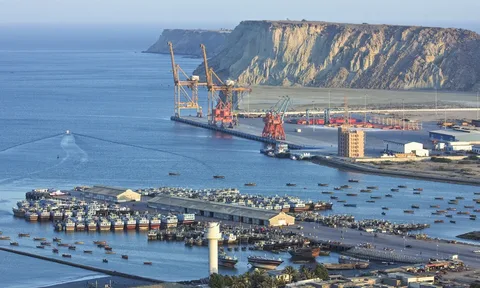
Gwadar Port is stepping into a massive new role on the global stage. Traditionally known as the crown jewel of the China-Pakistan Economic Corridor (CPEC), Gwadar is now poised to integrate with the International North–South Transport Corridor (INSTC).
With Russian Deputy Prime Minister Alexey Overchuk explicitly backing the link, this move shifts regional geopolitics and transforms Pakistan into the ultimate Eurasian trade hub.
What is the INSTC?
The INSTC is a 7,200-kilometer multimodal transit network (using ships, rail, and road) originally founded by India, Iran, and Russia to move freight between the Indian Ocean, the Caspian Sea, and Northern Europe. By bypassing the crowded Suez Canal, the corridor slashes traditional transit times from 40 days down to just 20 to 25 days.
Why the Gwadar Link Changes Everything
Integrating Gwadar into this network is a geopolitical game-changer for three major reasons:
Historic Surge in Activity: In mid-2026, Gwadar Port recorded a historic surge in trade volume, driven by Pakistan’s $1 billion initiative to route Central Asian trade through its deep-sea ports.
The Deep-Water Advantage: Gwadar is a natural deep-sea port capable of handling massive mega-ships that other regional ports cannot. Its direct access to the Arabian Sea bypasses the heavily congested Strait of Hormuz.
Turning Rivals into Partners: Historically, India used the INSTC (via Iran’s Chabahar port) to bypass Pakistan. Connecting Gwadar means Chabahar and Gwadar can transition from rival ports into an integrated, powerhouse transport matrix.
By dissolving Cold War-era mistrust and cementing a long-term economic roadmap with Russia through 2030, Pakistan is cutting freight transit times to Central Asia by 40% and logistics costs by 30%. Gwadar is no longer just a regional port—it is the bridge connecting CPEC with the Eurasian trade infrastructure.