Top Trending in Gwadar: Major Developments and Opportunities in 2026
Gwadar continues to attract attention in 2026 because several different parts of the city are developing at the same time. Port activity, infrastructure, housing, commercial development, tourism, fisheries, connectivity and urban planning are all contributing to the conversation around Gwadar. Recent information from the Gwadar Development Authority and other sources shows that development is not limited to one large project; roads, public facilities, maritime infrastructure and long-term urban planning are progressing across different areas. The GDA’s current information also highlights Gwadar’s planned Central Business District, commercial schemes, house schemes, industrial schemes and major infrastructure as important components of the city’s development framework.
For anyone searching for top trending in Gwadar, this broader picture is important. A city can trend because of a new road, a major airport, a housing project, a port announcement or a change in business activity, but the more meaningful trend is usually the combination of several developments moving together. In 2026, Gwadar’s story includes both established infrastructure and newer initiatives designed to improve urban services and economic activity. More than 10 infrastructure and development projects were reported as completed during the 2026–27 fiscal year, including road construction, blacktopping, drainage and public recreation facilities.
Why Gwadar Is Trending in 2026
Gwadar is trending because it sits at the intersection of several major economic themes. It is a coastal city with a deep-sea port, a major airport project, links to CPEC, a long-term smart city plan and an expanding network of roads and public infrastructure. The federal Public Sector Development Programme for 2026–27 also includes more than Rs14.2 billion for Gwadar-linked development and connectivity projects, covering roads, the airport, rail connectivity planning, port-related schemes and civic infrastructure.
This does not mean every planned project will automatically produce immediate economic or property gains. Development takes time, and the practical impact of infrastructure depends on factors such as business activity, population growth, utilities, employment and actual demand. That distinction is particularly important for people researching Gwadar real estate because announcements and plans should be examined alongside on-ground development. The current trend, therefore, is best understood as a developing ecosystem rather than a single investment story.

Gwadar’s Growing Strategic Importance
Gwadar’s strategic location on the Arabian Sea remains one of its most important characteristics. The Gwadar Development Authority describes the city as having potential to become a major trade hub because of its location, port infrastructure and connection with regional markets. Its official information also identifies the city’s relationship with CPEC and highlights the potential role of Gwadar in trade, investment and regional connectivity.
The strategic importance of Gwadar also explains why infrastructure receives so much attention. Roads connect the port with other regions, airports support passenger and cargo connectivity, industrial areas can support business activity, and housing and commercial areas provide space for the people and companies participating in the local economy. When these pieces develop together, the city becomes easier to understand as a long-term urban and economic project rather than simply a coastal property market.
1. Gwadar Port and Maritime Trade
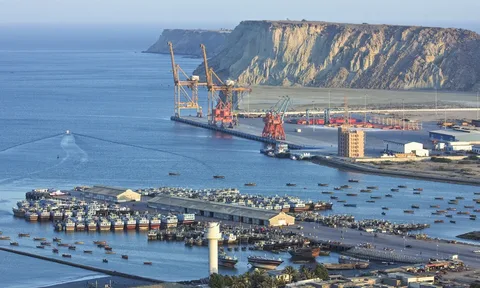
Gwadar Port remains one of the most important subjects in discussions about the city’s future. Its location gives Pakistan access to the Arabian Sea and creates opportunities connected with shipping, logistics, warehousing, transportation and maritime services. The wider development strategy also includes port-related infrastructure and connectivity projects, meaning the port cannot be viewed separately from roads, industrial areas and other supporting facilities. Federal development allocations for 2026–27 include port-linked schemes such as the Off-Dock Terminal, East Bay Expressway Phase-II and a project management cell for the proposed Gwadar Shipyard.
The trend around the port is therefore broader than the movement of ships alone. A functioning maritime economy needs transport companies, suppliers, warehouses, skilled workers, financial services, maintenance businesses and commercial facilities. As these supporting activities expand, they can create additional demand for commercial spaces and services. The pace and scale of that growth will depend on actual cargo volumes, business investment and the successful implementation of supporting infrastructure.
New Activity Around Fisheries and Marine Business
Another important trend in Gwadar is the development of the fisheries sector. On September 18, 2026, the Fish Auction Hall and Mall Holding Section at the Surbandar Fish Landing Jetty were inaugurated, with a formal fish auction system being launched to make buying and selling more organized. According to Gwadar Pro, the initiative is intended to provide fishermen with better facilities and improve transparency in the trading of fish.
This development matters because Gwadar’s economy is not based only on large-scale infrastructure. Fisheries have a direct connection with local communities and the coastal economy. Improving landing facilities, auction systems and related infrastructure can support existing economic activity while creating opportunities for transportation, cold storage, processing and other marine-related businesses. This is one example of how the city’s development story is becoming more diverse.
2. New Gwadar International Airport
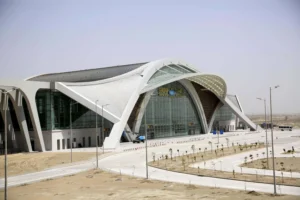
The New Gwadar International Airport is another major trend shaping the city’s connectivity. The Gwadar Development Authority describes it as a major airport located in Gurandani, around 26 kilometres northeast of the old airport, covering approximately 4,300 acres. The airport is part of the broader infrastructure network intended to strengthen Gwadar’s connections with other parts of Pakistan and international destinations.
An airport can influence a city in several ways beyond passenger travel. Better air connectivity can support business visits, tourism, government activity, professional services and movement of specialized personnel. However, the long-term economic impact depends on route availability, passenger demand, airline operations and the development of surrounding commercial activity. For property and business observers, the airport is therefore one important component of Gwadar’s infrastructure picture rather than a standalone guarantee of market growth.
3. Gwadar Smart Port City Master Plan
The Gwadar Smart Port City Master Plan is one of the most significant long-term trends in the city. In March 2026, Gwadar Pro reported that the planning framework included 14 neighborhoods or towns to be developed in phases, with land designated for residential, commercial and mixed-use areas, roads and public facilities. The framework also identified several possible implementation models, including land acquisition, land pooling, partnerships and private-sector participation.
The significance of a master plan is that it provides a structure for urban growth. Instead of development occurring randomly, a planned city can allocate space for housing, businesses, roads, public services and other facilities. For property buyers, this makes it important to understand the location and legal status of a project within the broader planning environment before making a decision.
Planned Residential and Commercial Expansion
The long-term urban programme is also creating discussion around residential and commercial development. A 2026 report on the city’s development programme described a proposed multi-year urban framework covering areas such as a Central Business District, Special Economic Zones, commercial centres, public spaces, housing and ecological corridors. The programme also includes infrastructure priorities such as roads, drainage, sewerage improvements and street lighting.
This creates several potential categories of activity: residential housing for local and incoming workers, commercial spaces for businesses, hospitality for visitors and support services for industrial and maritime activity. Yet development plans should always be separated from completed projects. A planned facility is not the same as an operational facility, so buyers and businesses should verify implementation status before relying on future projections.
4. Infrastructure and Road Development
Road development is one of the most visible trends in Gwadar during 2026. Gwadar Pro reported that more than 10 development projects had been completed during the fiscal year, including blacktopping of several roads, link-road construction, drainage work and improvements connecting different parts of the city. Projects mentioned included roads around East Bay, Marine Drive, Shaheen Chowk, Airport Road and other areas.
Roads are essential because economic activity depends on movement. A commercial area needs customers and deliveries, a housing project needs access, tourism needs convenient routes and port-related businesses need reliable transportation connections. Better roads can gradually reduce the practical distance between different parts of a city, although the resulting economic effect depends on how strongly businesses and residents actually use those connections.
5. CPEC and Gwadar’s Economic Role
The China-Pakistan Economic Corridor (CPEC) remains closely associated with Gwadar’s development. The city’s port, connectivity projects, Free Zone and supporting infrastructure have all been discussed within the broader CPEC framework. The Planning Commission has also identified Gwadar-related priorities involving trade, port development, tourism and connectivity.
CPEC should not be understood as a single construction project. It is a wider framework involving infrastructure, energy, transportation and economic connectivity. For Gwadar, the practical question is how effectively these investments translate into operating businesses, employment, trade and urban activity. That is why current trends in roads, port facilities, industrial development and services are just as important as headline announcements.
6. Real Estate and Housing Trends
Real estate remains one of the most searched topics associated with Gwadar. Residential plots, commercial plots, housing schemes and future development areas continue to attract attention from buyers who are interested in the city’s long-term expansion. The GDA itself lists commercial schemes and house schemes among its areas of activity, reflecting the role of planned development in the city’s urban structure.
At the same time, property buyers should examine Gwadar’s market carefully rather than treating every project or price claim as equivalent. A 2026 private market report from Hyde Realtors characterizes Gwadar’s property market as thin and illiquid and argues that infrastructure development has not automatically translated into comparable levels of property demand. That assessment is a private market analysis rather than an official government measurement, but it highlights an important consideration: infrastructure and property liquidity are related but not identical.
What Property Buyers Should Examine
Anyone considering property in Gwadar should look beyond marketing language. The project’s approval status, ownership documentation, development progress, location, road access, utilities, possession status, developer record and resale activity are all relevant factors. Buyers should also distinguish between a project’s announced future facilities and infrastructure that already exists.
A useful property checklist includes:
- Verify the relevant approval and documentation.
- Confirm the exact location and access roads.
- Check development and possession status.
- Understand the complete payment schedule.
- Compare asking prices with actual market activity.
- Examine available utilities and nearby services.
- Consider the potential resale market rather than relying only on future price projections.
These steps are particularly useful in a developing city because the gap between a planned project and a functioning neighborhood can be substantial.
7. Canadian City Gwadar and Housing Demand
Canadian City Gwadar is part of the wider conversation around planned housing and real estate development in Gwadar. For buyers researching housing opportunities, a project should be evaluated through practical factors such as location, documentation, development status, accessibility, available facilities and payment options. Canadian City can be presented as one of the housing projects being considered within the broader Gwadar property market, while buyers should independently verify project-specific claims and approvals before purchasing.
The broader trend is that housing becomes increasingly relevant as urban development expands. Workers, business owners, families and service providers need places to live close to employment and commercial activity. That makes residential planning an important part of Gwadar’s long-term urban development, but actual housing demand will depend on population growth, employment and the pace at which other economic sectors become operational.

8. Commercial Property and Business Opportunities
Commercial property is another major topic in top trending in Gwadar searches. As infrastructure improves, businesses may look for shops, offices, warehouses, restaurants, hotels, logistics facilities and other commercial spaces. The GDA’s official platform identifies commercial schemes and a Central Business District among its development-related areas, demonstrating the importance of commercial activity in the city’s planning framework.
The most meaningful commercial opportunities generally emerge when there is real customer demand behind them. A shop in an active neighborhood is different from a shop located in an area waiting for future population growth. For that reason, business owners and investors should examine current footfall, nearby residents, access, utilities and operating businesses rather than relying entirely on projected future activity.
9. Tourism and Coastal Development
Gwadar’s coastline gives tourism a natural place in discussions about the city’s future. Beaches, coastal landscapes, Marine Drive and the Arabian Sea provide the foundation for hospitality, recreation and tourism-related businesses. Pakistan’s Planning Commission has previously emphasized the need to develop tourism infrastructure in Gwadar, including coastal resorts, while also discussing international hospitality investment.
Tourism can create a different type of economic activity from ports and industry. Hotels, restaurants, transportation, recreational facilities and local retail can benefit when visitor numbers increase. For Gwadar, the challenge is turning the city’s natural coastal advantages into reliable tourism infrastructure and services while ensuring development remains compatible with local communities and the environment.
10. Fisheries and the Blue Economy
The fisheries sector remains deeply connected with Gwadar’s identity and economy. Recent activity at the Surbandar Fish Landing Jetty shows an effort to improve the organization of fish auctions and facilities for fishermen. Such developments are important because the coastal economy includes far more than ports and large infrastructure projects.
The wider concept of a blue economy includes fisheries, marine services, coastal tourism, shipping and other activities connected with ocean resources. Gwadar’s location provides opportunities across these areas, although each requires investment, skills, infrastructure and effective management. The growth of marine-related businesses could eventually contribute to a more diversified local economy.
11. Energy, Water and Urban Services
A modern city needs reliable basic services. Roads and airports attract attention, but water supply, sanitation, drainage, electricity, waste management and municipal services determine how comfortably people can actually live and work in an area. The 2026–27 federal development programme includes civic and municipal initiatives for Gwadar, including sanitation, landfill development, water supply and treatment, Old Town rehabilitation and the Gwadar Safe City Project.
These projects are especially important for long-term housing and commercial development. A residential project can be attractive on paper, but residents need dependable water, electricity, roads, drainage and nearby services. As Gwadar’s urban footprint expands, the quality and reliability of these systems will remain a major factor in determining how quickly different neighborhoods become fully functional.
12. Digital Payments and Modern Business
The modernization of financial services is another trend connected with Pakistan’s wider economic transformation. In September 2026, Gwadar Pro reported that HBL and UnionPay signed a memorandum of understanding aimed at expanding digital payment services in Pakistan. Although the announcement is broader than Gwadar alone, developments in digital payments can support modern commerce by making transactions easier for consumers and businesses.
For a developing commercial city, digital infrastructure can complement physical infrastructure. Businesses increasingly depend on online marketing, electronic payments, digital banking and technology-enabled customer services. Gwadar’s future business environment will therefore be influenced not only by roads and buildings but also by how effectively modern digital services become integrated into everyday economic activity.
13. Education, Skills and Employment
Development requires people with the right skills. Gwadar’s future economy could need workers in logistics, hospitality, fisheries, construction, transportation, engineering, information technology, retail and other service sectors. The federal development programme for 2026–27 includes allocations connected with the University of Gwadar and scholarships for students from Gwadar, while recent reporting has also highlighted skills and digital marketing initiatives.
Skills development can help local communities participate more directly in emerging economic opportunities. This is especially important because infrastructure alone does not create a complete economy. Businesses need trained employees, and residents need access to education and employment if urban growth is to become sustainable over the long term.
14. Gwadar’s Connection With Regional Markets
Gwadar’s geographic position gives it relevance beyond the city itself. The port is located on the Arabian Sea and is associated with potential trade connections involving Pakistan, China, Central Asia, the Middle East and other regional markets. Government planning discussions have included engagement with Afghan transit traders, feasibility studies for RO-RO terminals and consultations with international shipping companies as part of longer-term development priorities.
Connectivity, however, is a process rather than a switch that suddenly turns on. Roads, railways, ports, customs facilities, warehouses and commercial networks must work together for regional trade to become efficient. This is why projects such as M-8 connectivity, rail planning and port-related infrastructure remain important trends for people following Gwadar’s development.
15. What Could Shape Gwadar’s Next Phase
The next phase of Gwadar will depend on how successfully infrastructure translates into everyday economic activity. The city already has major infrastructure assets, while new road, civic, maritime and planning initiatives continue to emerge. The 2026–27 development programme and the GDA’s current planning framework indicate continued attention to connectivity, urban services, port-related infrastructure and planned expansion.
For anyone tracking top trending in Gwadar, the most useful approach is therefore to watch several indicators at once: port and cargo activity, airport connectivity, business openings, industrial investment, housing occupancy, road completion, municipal services, tourism activity and employment. These indicators provide a more complete picture than property advertisements or individual announcements. Gwadar’s development story is still evolving, and the difference between a promising plan and measurable economic activity is something every researcher, investor and business owner should keep in mind.
FAQs
1. What is trending in Gwadar in 2026?
Major trends include road and infrastructure development, the New Gwadar International Airport, the Gwadar Smart Port City Master Plan, port-related activity, fisheries, tourism, housing and commercial development. Recent reports also show continued federal allocations for Gwadar-linked infrastructure and connectivity.
2. Why is Gwadar important for Pakistan?
Gwadar is strategically located on the Arabian Sea and has a deep-sea port connected with Pakistan’s wider regional connectivity plans. Its development is also associated with CPEC, transportation infrastructure, trade, logistics and urban expansion.
3. Is real estate still a major trend in Gwadar?
Yes, real estate remains an important topic associated with Gwadar, including residential and commercial development. However, property buyers should independently verify documentation, approvals, development status, utilities, location and actual market demand before making a purchase.
4. What role does the Gwadar Smart Port City Master Plan play?
The master plan provides a framework for phased urban development. In 2026, reporting indicated a framework involving 14 neighborhoods with designated residential, commercial, mixed-use, road and public-facility areas.
5. What should I check before investing in a Gwadar housing project?
Check the project’s legal and approval documentation, exact location, development status, possession, infrastructure, utilities, payment terms and resale activity. It is also important to distinguish between facilities that currently exist and facilities that are only proposed for the future.